


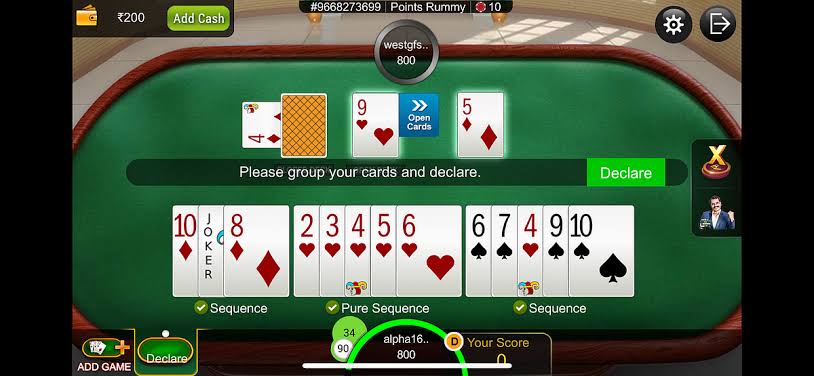
Rummy 51 is a variation of the traditional rummy card game in which the number 51 can represent an important scoring or opening requirement, depending on the version being played. Because different platforms and groups may use “Rummy 51” differently, players should always check the specific rules before starting. One commonly described format requires the first meld to reach at least 51 points in a single turn.
What Is Rummy 51?
Rummy 51 follows the basic draw-and-discard concept of rummy. Players receive cards and attempt to arrange them into valid sequences and sets. The objective is generally to organize the complete hand correctly and finish before the other players.
The main feature of the 51-point-opening version is that a player cannot simply place a small combination on the table. Their initial meld must reach the required 51-point value.
For example:
- J♥ Q♥ K♥ = 30 points
- 7♠ 7♥ 7♦ = 21 points
- Total = 51 points
This combination reaches the opening requirement.
Rummy 51 Rules
The exact rules can vary, but a commonly described 51-point-opening format works as follows:
- Players draw and discard cards during their turns.
- Cards are arranged into sequences and sets.
- The first table meld must reach at least 51 points.
- The qualifying combinations generally need to be made during the same opening turn.
- After opening, players can continue building valid combinations.
- The round normally ends when a player successfully gets rid of their cards according to the applicable rules.
It is important not to confuse this format with 51 Pool Rummy, where 51 may instead refer to a cumulative elimination limit.
Sequences in Rummy 51
A sequence is a group of consecutive cards from the same suit.
For example:
5♥ 6♥ 7♥
is a valid sequence.
A sequence generally contains three or more consecutive cards. In traditional Indian Rummy, a pure sequence contains consecutive cards of the same suit without a joker replacing a card.
Sets in Rummy 51
A set consists of cards having the same rank but different suits.
For example:
8♠ 8♥ 8♦
forms a valid three-card set.
A four-card set could be:
K♠ K♥ K♦ K♣
Sets and sequences can be combined to build a strong hand and, in the 51-point-opening format, can help reach the opening threshold.
51-Point Opening Example
Suppose your hand contains:
J♣ Q♣ K♣
These cards are worth:
10 + 10 + 10 = 30 points
You also have:
7♠ 7♥ 7♦
which contributes:
7 + 7 + 7 = 21 points
Therefore:
30 + 21 = 51 points
You have reached the required opening value in a version that uses the 51-point opening rule.
How a Turn Works
A typical top rummy turn consists of three basic actions:
1. Draw
Take a card from the closed pile or, where permitted, the top of the discard pile.
2. Arrange or Meld
Organize cards into sequences or sets. In the 51-opening format, the first meld must satisfy the required threshold.
3. Discard
Finish the turn by placing an unwanted card onto the discard pile.
Draw-and-discard play is fundamental to many rummy variants.
Card Values
Card values depend on the particular Rummy 51 ruleset. This is one reason players should check the rules of their specific table.
In many rummy scoring systems, number cards carry their face value, while Jacks, Queens and Kings are worth 10 points. Traditional Indian Rummy commonly treats printed and wild jokers as zero points when calculating penalty points.
Rummy 51 Strategy
A good strategy begins with understanding the opening requirement.
Focus on connected cards:
Cards that can become sequences are often more useful than isolated cards.
Look for high-value combinations:
In a 51-point-opening version, high-value cards can help you reach the threshold more quickly.
Avoid holding unnecessary high cards:
If the round ends while you still have unmatched cards, high-value cards can increase your penalty under many scoring systems.
Watch the discard pile:
Discarded cards can provide clues about the combinations other players may be collecting.
Use jokers carefully:
A joker can help complete an otherwise difficult combination, although the exact joker rules vary between versions.
Rummy 51 vs 51 Pool Rummy
These two names can sound similar but may describe different formats.
| Feature | Rummy 51 Opening Format | 51 Pool Rummy |
|---|---|---|
| Meaning of 51 | Opening requirement | Pool/elimination threshold |
| Main focus | Reach 51 to open | Manage cumulative scores |
| Gameplay | Draw, arrange and discard | Draw, arrange and discard |
| Rules | Depends on variant | Pool-rummy rules apply |
| Best approach | Build a strong opening | Minimize penalty points |
The term “Rummy 51” is not completely standardized, so checking the rules of the particular game is important.
Tips for Beginners
If you are learning Rummy 51 for the first time:
- Learn the difference between sets and sequences.
- Understand exactly how your version calculates 51 points.
- Do not rush to discard cards that could complete a sequence.
- Keep track of cards already discarded.
- Try to reduce unmatched cards as the round progresses.
- Check the game’s official rules before playing because different versions can use different card values, joker rules and scoring systems.
Conclusion
Rummy 51 adds an interesting layer to traditional rummy by making 51 an important part of the game. In the commonly described opening-threshold version, players must build valid combinations totaling at least 51 points before they can make their initial meld. However, the term can also refer to other formats such as 51 Pool Rummy, so the exact rules should always be confirmed before playing.