


There’s a quiet kind of trust we place in our tap water. You turn the handle, it flows, and that’s usually the end of the story. No questions asked. But every now and then, something nudges that trust just a little — a faint taste, a cloudy swirl, or maybe just a thought that lingers longer than it should.
Is this really as clean as it looks?
It’s not a dramatic realization. More like a slow curiosity that builds over time. And once it’s there, you start noticing things you didn’t before.
The Layers We Don’t See
Water is rarely just “water.” By the time it reaches your home, it has passed through treatment plants, pipelines, storage systems — each step adding or removing something along the way.
What’s left is generally safe, yes. But “safe” doesn’t always mean ideal.
That’s where systems like a multi stage filtration system come into the picture. Instead of relying on a single filter, these setups work in layers — each stage targeting different types of impurities. Sediments, chlorine, organic compounds… one step at a time, the water is refined.
It’s a bit like peeling back layers of an onion, except in reverse — you’re removing what doesn’t belong, gradually, until what’s left feels cleaner and more balanced.
And the beauty of it is, you don’t see any of this happening. It all takes place behind the scenes.
A Closer Look at What Actually Gets Filtered
If you’ve ever wondered how these systems manage to remove such tiny impurities, the answer lies in something surprisingly precise.
Processes like semipermeable membrane filtration are designed to allow water molecules through while blocking larger contaminants. It’s incredibly fine — the kind of filtration that works on a microscopic level.
You don’t need to understand the science in detail to appreciate the result. Water that feels lighter, tastes cleaner, and behaves the way you expect it to.
Still, it’s fascinating to think about. That something so simple — turning on a tap — can involve such intricate processes behind the scenes.
The Simplicity of Fixing It at the Source
Not everyone wants a complex system installed across their entire home. And honestly, not every situation calls for it.
Sometimes, the most effective approach is also the simplest — focusing on the point where you use water the most.
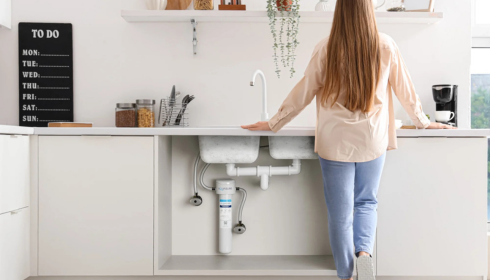
A kitchen sink water filter does exactly that. It targets the water you drink and cook with, right where you need it. No major changes to your plumbing, no complicated setup.
It’s practical. Direct. And for many households, it’s enough to make a noticeable difference.
You fill a glass, take a sip, and immediately feel that something has improved. Not dramatically, but clearly.
The Subtle Changes That Add Up
What’s interesting is how quickly these changes become part of your routine.
At first, you notice the taste. Then you notice how your tea or coffee feels slightly different — smoother, maybe. Cooking feels a bit more consistent. Even washing fruits and vegetables feels more reassuring.
These are small things, individually. But together, they shift how your kitchen feels as a whole.
And once you get used to it, it’s hard to imagine going back.
It’s Not Always About Big Problems
One of the misconceptions about water filtration is that it’s only necessary when there’s a major issue. Contamination, visible impurities, strong odors.
But in reality, many people turn to filtration not because something is wrong, but because they want something better.
Better taste. Better clarity. Better confidence.
It’s less about fixing a problem and more about improving an experience.
Finding What Works Without Overthinking It
The world of water filtration can feel overwhelming if you dive too deep. There are so many options, technologies, and opinions that it’s easy to get stuck.
But it doesn’t have to be complicated.
Start with what you notice. Taste, smell, clarity — these are good indicators. If something feels off, there’s usually a solution that addresses it directly.
You don’t need the most advanced system on the market. You just need one that fits your needs.
And often, that’s simpler than it sounds.
The Quiet Comfort of Knowing
There’s a certain peace of mind that comes with trusting your water.
Not questioning it. Not hesitating before using it. Just… knowing it’s good.
It’s not something you think about constantly, but it sits there in the background, making everyday tasks a little easier.
And that’s the thing — good water doesn’t demand attention. It blends into your routine so seamlessly that you almost forget it’s there.
Bringing It Back to Something Simple
At its core, water should feel simple.
You shouldn’t have to analyze it, question it, or adjust your habits around it. It should just work — clean, clear, and reliable.
Whether you choose a layered filtration approach, a more advanced membrane process, or a simple kitchen solution, the goal is the same.
To bring water back to what it’s meant to be.
Something you can trust without thinking twice.
And when you reach that point, you realize — it was never about the system itself. It was about restoring something that should’ve felt right all along.