
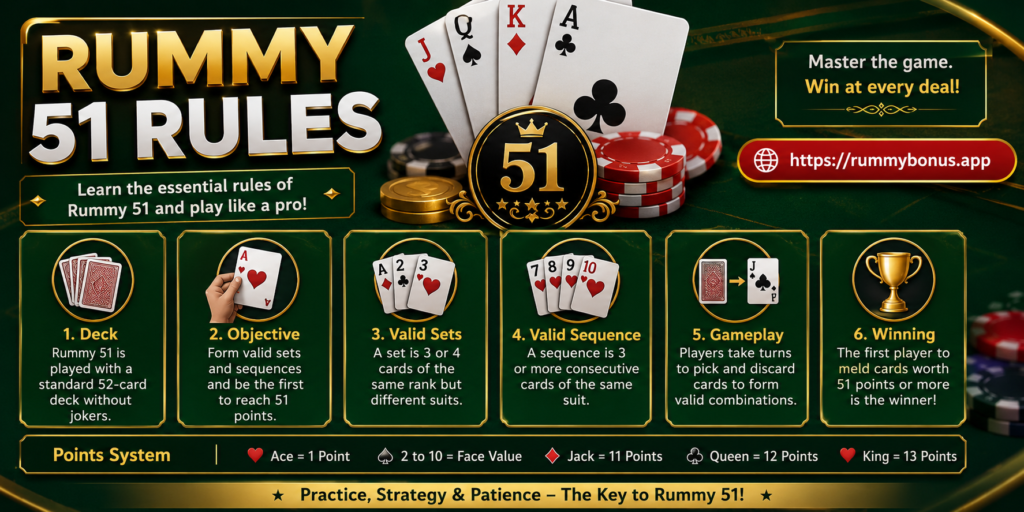
Rummy 51 is a variation of the traditional rummy card game in which players arrange cards into valid sequences and sets. One commonly described version has a special 51-point opening rule: before a player can begin laying cards on the table, the first combinations played must have a combined value of at least 51 points in a single turn.
The term “Rummy 51” can also refer to 51 Pool Rummy, where 51 is the elimination score rather than the opening requirement. Because these formats are different, players should check the rules of the particular game or platform before starting.
What Is Rummy 51 Rules?
Rummy 51 follows the basic draw-and-discard structure of rummy. Players receive cards, draw one card during their turn, arrange cards into combinations, and discard one card. The objective is generally to organize the hand into valid combinations and get rid of the cards before the other players.
The main feature of the 51-point-opening version is that players cannot simply place small combinations on the table whenever they want. Their first opening must satisfy the required 51-point total. For example:
- J♥ Q♥ K♥ = 30 points
- 7♠ 7♥ 7♦ = 21 points
- Total = 51 points
This combination reaches the opening requirement and can qualify the player to open, assuming the table follows this version of the rules.
Rummy 41 Setup
The exact setup can vary between versions, but a commonly described Rummy 51 format uses two standard decks together with jokers and generally deals 13 cards to each player. It is commonly described for two to four players.
After the cards are dealt, the remaining cards form the draw pile. A card is placed face up to begin the discard pile. Players then take turns drawing, arranging their cards, and discarding.
Before beginning, players should agree on:
- Number of players
- Number of cards dealt
- Number and type of jokers
- Card-value system
- Opening requirement
- Declaration rules
- Scoring method
This is important because rummy rules can differ significantly between variants.
Objective of Rummy 51
The primary objective is to arrange cards into valid combinations and eventually get rid of the cards in your hand.
The two basic combinations are sequences and sets.
A sequence contains consecutive cards of the same suit, such as:
5♥ 6♥ 7♥
A set contains cards of the same rank in different suits, such as:
8♠ 8♥ 8♦
The player must follow the combination rules applicable to the specific Rummy 51 version being played.
Rummy 51 Card Values
Understanding card values is particularly important because the opening requirement depends on points.
A commonly described Rummy 51 scoring system uses:
| Card | Value |
|---|---|
| 2–10 | Face value |
| Jack | 10 |
| Queen | 10 |
| King | 10 |
| Ace | 11 |
| Joker | Depends on the applicable rules |
For example, a 7 is worth 7 points, while J-Q-K is worth 30 points.
However, this should not be confused with standard Indian 13-card rummy scoring, where A, K, Q and J are commonly valued at 10 points and jokers carry zero points for penalty calculation.
What Is a Sequence?
A sequence is a group of consecutive cards belonging to the same suit.
Examples include:
3♣ 4♣ 5♣
8♦ 9♦ 10♦
J♠ Q♠ K♠
A sequence normally contains at least three cards, although the exact requirements can depend on the variant.
Sequences are useful because they allow players to connect several cards and reduce the number of ungrouped cards in their hands.
What Is a Set?
A set consists of cards having the same rank but different suits.
For example:
6♠ 6♥ 6♦
is a valid three-card set.
A four-card set can be:
K♠ K♥ K♦ K♣
Sets do not require consecutive cards. Instead, all cards share the same rank.
When trying to reach the 51-point opening requirement, sets can be combined with sequences to reach the required total.
The 51-Point Opening Rule
The 51-point opening rule is the defining feature of this Rummy 51 format.
A player who has not opened must normally place combinations worth at least 51 points in total during one turn.
For example:
J♣ Q♣ K♣
J = 10
Q = 10
K = 10
Total = 30 points.
The player can combine this with:
7♠ 7♥ 7♦
7 + 7 + 7 = 21 points.
Therefore:
30 + 21 = 51 points
The player has reached the required opening total.
A player with only a 30-point combination would not meet a 51-point opening requirement. They would generally need to continue drawing and arranging cards until they can make a qualifying opening.
Can You Open With Exactly 51 Points?
Yes, if the particular version requires a minimum of 51 points, exactly 51 meets the requirement.
For example:
10♥ J♥ Q♥ = 30
and
7♠ 7♥ 7♦ = 21
Total:
30 + 21 = 51
This is a straightforward example of an opening that reaches the minimum threshold.
Of course, a combination worth more than 51 can also qualify if all the cards form valid combinations and the table’s rules permit them.
Can You Lay Off Cards Before Opening?
In the commonly described 51-point-opening format, players generally cannot freely add cards to existing combinations before completing their own qualifying opening.
The player must first satisfy the 51-point requirement.
After successfully opening, the rules generally become more flexible, allowing additional combinations and, where permitted, cards to be added to existing melds.
How a Turn Works
A typical turn has three basic stages.
Draw a Card
The player begins by taking a card from the available draw pile or, where the rules permit, the discard pile.
The new card can help complete a sequence, set, or opening combination.
Arrange and Meld
The player then checks the cards in their hand.
Before opening, the player needs to concentrate on reaching the required 51-point total.
After opening, the player can normally continue building additional valid combinations.
Discard a Card
At the end of the turn, the player discards one unwanted card.
This keeps the game moving and gives the next player an opportunity to choose from the available cards according to the rules.
How Jokers Work in Rummy 51
Jokers can be valuable because they may substitute for missing cards in valid combinations.
For example:
5♥ Joker 7♥
may represent:
5♥ 6♥ 7♥
if the applicable rules allow the joker to substitute for the missing 6♥.
A joker may also be used to complete a set where permitted.
However, joker rules are not identical across all rummy variants. Standard Indian rummy, for example, distinguishes between pure sequences and impure sequences, and a joker cannot normally replace a missing card in a pure sequence.
Therefore, always check the joker rules before playing.
Example of a Rummy 51 Opening
Suppose a player has these cards:
- J♥
- Q♥
- K♥
- 7♣
- 7♦
- 7♠
- 4♥
- 5♥
- 9♣
- Joker
- 2♦
- 6♠
- 10♣
The player can identify:
J♥ Q♥ K♥ = 30 points
and:
7♣ 7♦ 7♠ = 21 points
Combined:
30 + 21 = 51 points
Therefore, the player has a qualifying opening in a version using the 51-point opening rule.
The remaining cards can then be organized into additional combinations during subsequent play.
Rummy 51 Winning Rules
Reaching 51 points does not automatically mean that a player has won.
The 51-point requirement is an opening condition in this particular version. The player must still complete the rest of the hand according to the applicable rules.
Generally, the objective is to arrange all cards into valid combinations and be the first player to complete the required declaration or go out.
The exact winning condition can differ between Rummy 51 implementations, so players should check the rules provided by the table or platform.
Rummy 51 Scoring
Scoring also varies between different rummy variants.
In a traditional rummy format, players who still have cards when another player goes out may receive points based on the cards remaining in their hands. In standard Indian rummy, for example, face cards and aces are generally counted at 10 points while jokers have zero penalty value.
In a Rummy 51 format with its own scoring system, the values may be different. This is another reason to confirm the specific rules before starting a game.
Rummy 51 vs 51 Pool Rummy
One of the most important things for beginners is understanding the difference between Rummy 51 and 51 Pool Rummy.
| Feature | Rummy 51 Opening Format | 51 Pool Rummy |
|---|---|---|
| Meaning of 51 | Opening requirement | Elimination score |
| Main objective | Complete valid combinations | Complete valid combinations while avoiding the pool limit |
| Opening | Commonly requires 51+ points | Depends on the pool-rummy rules |
| Score limit | Depends on the variant | Players can be eliminated at 51 points |
| Game structure | Draw-and-discard format | Pool-based scoring |
In 51 Pool Rummy, a player’s cumulative score reaches the pool limit and the player is eliminated. The number 51 therefore has a completely different role from the 51-point opening rule.
Common Mistakes in Rummy 51
Opening With Less Than 51 Points
One of the biggest mistakes is placing a combination on the table before reaching the required opening total.
If the table requires 51 points, a 40- or 45-point opening does not qualify.
Ignoring Card Values
Players should calculate the value of their potential opening before placing cards down.
Knowing the values of number cards, face cards and aces makes it easier to identify combinations that can reach 51.
Discarding Useful Cards
A card that appears unnecessary may actually complete a future sequence or set. Think about possible combinations before discarding.
Focusing Only on High Cards
High-value cards can help reach the opening threshold, but holding too many unconnected high cards can become costly if another player finishes first.
Forgetting Variant Differences
The biggest mistake may be assuming that every game called “Rummy 51” follows exactly the same rules. Some references use the term for the 51-point opening format, while others use it for 51 Pool Rummy.
Tips for Playing Rummy 51
A good approach is to organize your hand immediately after receiving the cards.
Separate cards that appear to form sequences from cards that could form sets. This makes potential combinations easier to identify.
Keep track of cards that could help you reach 51 points. If you already have a strong sequence worth 30 points, for example, you can focus on finding another valid combination worth at least 21 points.
Pay attention to discarded cards as well. They can provide clues about which cards other players may be collecting.
At the same time, avoid holding too many disconnected high-value cards. If another player finishes before you, those cards can increase your remaining score depending on the scoring system.
Frequently Asked Questions
What does 51 mean in Rummy 51?
In the 51-point-opening version, 51 is the minimum total value required for the first opening meld. The qualifying combinations are generally played together in a single turn.
Can I open with more than 51 points?
Generally, yes. If the rule says the opening must be at least 51 points, any valid opening meeting or exceeding that minimum can qualify, subject to the specific rules of the game.
Can I open with exactly 51 points?
Yes. Exactly 51 meets a minimum opening requirement of 51.
Can I lay cards before reaching 51?
In the commonly described 51-point-opening format, players generally need to complete the qualifying opening before freely laying off cards.
Is Rummy 51 the same as 51 Pool Rummy?
No. The terms are sometimes used for different formats. In the opening version, 51 refers to the first meld requirement. In 51 Pool Rummy, 51 generally refers to the score threshold for elimination.
How many cards are dealt in Rummy 51?
A commonly described version deals 13 cards to each player, although the setup can vary between versions.
Are jokers allowed?
Jokers are used in many rummy variants, but their exact value and permitted uses depend on the rules of the particular version.
Final Thoughts
Rummy 51 adds an interesting strategic element to the traditional rummy format because players need to think beyond simply creating small sequences and sets. In the 51-point-opening version, the key challenge is building a valid opening worth at least 51 points before proceeding with normal play.
The basic strategy is to organize your cards carefully, identify potential sequences and sets, understand the card-value system, and plan your opening before making a move. Most importantly, confirm whether the game uses the 51-point opening rule or 51 Pool Rummy rules, because the meaning of “51” changes between these formats.
With a clear understanding of the rules and careful card organization, beginners can learn the structure of Rummy 51 and make more informed decisions during each turn.